Tutorial de Geração Aumentada por Recuperação (RAG): Arquitetura, Implementação e Guia para Produção
De RAG básico à produção: chunking, busca vetorial, reranking e avaliação em um único guia.
Este tutorial de Geração Aumentada por Recuperação (RAG) é um guia passo a passo, focado em produção, para a construção de sistemas RAG do mundo real.
Se você está procurando por:
- Como construir um sistema RAG
- Arquitetura RAG explicada
- Tutorial RAG com exemplos
- Como implementar RAG com bancos de dados vetoriais
- RAG com reclassificação (reranking)
- RAG com pesquisa na web
- Melhores práticas de RAG em produção
Você está no lugar certo.
Este guia consolida conhecimento prático de implementação de RAG, padrões arquitetônicos e técnicas de otimização usadas em sistemas de IA em produção.
Se você também mantém um corpus de notas autoradas por humanos, segunda explicada para engenheiros detalha o que a PKM curada preserva — julgamento, contexto em evolução — ao lado do que a recuperação aumenta no momento da consulta.

Mapa do Cluster RAG (Leia nesta Ordem)
Se você quer o caminho mais rápido através do cluster RAG, use este mapa:
- Você está aqui: Visão geral do RAG + pipeline ponta a ponta (esta página)
- Chunking (base da qualidade de recuperação): Estratégias de Chunking no RAG
- Embeddings de texto (APIs e Python): Embeddings de texto para RAG e pesquisa — endpoints de embedding Ollama e compatíveis com OpenAI, formato de recuperação, links para frente
- Armazenamentos vetoriais (escolhas de armazenamento + indexação): Comparação de Armazenamentos Vetoriais para RAG
- Profundidade de recuperação (quando a “pesquisa” não é suficiente): Pesquisa vs DeepSearch vs Pesquisa Profunda
- Reclassificação (geralmente o maior ganho de qualidade): Reclassificação com Modelos de Embedding
- Modelos de embeddings + reclassificadores (implementações práticas):
- Arquiteturas avançadas: Variantes Avançadas de RAG: LongRAG, Self-RAG, GraphRAG
- Recuperação de gráfico + vetor (GraphRAG em um banco de dados de gráficos): Banco de dados de gráficos Neo4j para GraphRAG, instalação, Cypher, vetores, operações — gráficos de propriedades, índices vetoriais e neo4j-graphrag em um só lugar
O que é Geração Aumentada por Recuperação (RAG)?
A Geração Aumentada por Recuperação (RAG) é um padrão de design de sistema que combina:
- Recuperação de informação
- Augmentação de contexto
- Geração de modelo de linguagem grande
Em termos simples, um pipeline RAG recupera documentos relevantes e os injeta no prompt antes que o modelo gere uma resposta.
Ao contrário do ajuste fino (fine-tuning), o RAG:
- Funciona com dados atualizados com frequência
- Suporta bases de conhecimento privadas
- Reduz a alucinação
- Evita o retreinamento de modelos grandes
- Melhora o fundamentação das respostas
Os sistemas RAG modernos incluem mais do que pesquisa vetorial. Uma implementação completa de RAG pode incluir:
- Reescrita de consulta
- Pesquisa híbrida (BM25 + pesquisa vetorial)
- Reclassificação com cross-encoder
- Recuperação em múltiplos estágios
- Integração com pesquisa na web
- Avaliação e monitoramento
Blueprint Mínimo de RAG em Produção (Implementação de Referência)
Use isso como um modelo mental (e um esqueleto inicial) para RAG em produção.
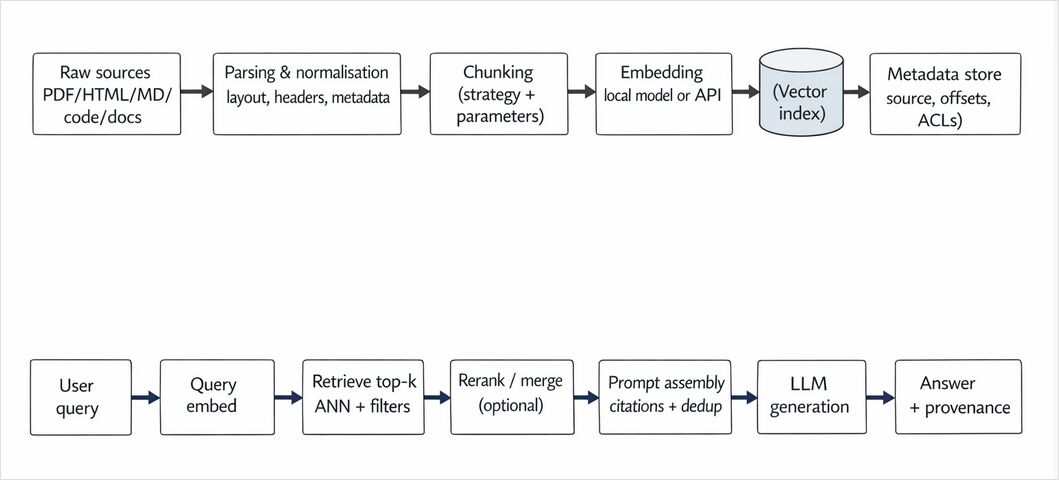
Pipeline de ingestão (offline ou contínuo)
- Coletar fontes (docs, tickets, páginas web, PDFs, código)
- Normalizar (extrair texto, limpar boilerplate, desduplicar)
- Dividir em blocos (Chunk) (escolher estratégia + sobreposição + metadados)
- Embarcar (Embed) (embeddings versionados)
- Upsert no índice (armazenamento vetorial + campos de metadados)
- Estratégia de reindexação quando embeddings ou chunking mudarem
Pipeline de consulta (online)
- Analizar / reescrever consulta (opcional)
- Recuperar candidatos (vetorial ou híbrido + filtragem de metadados)
- Reclassificar top-K com um cross-encoder / modelo de reclassificação
- Montar contexto (desduplicar, ordenar por relevância, adicionar citações)
- Gerar com prompt fundamentado (regras + comportamento de recusa)
- Registrar (Log) (conjunto de recuperação, conjunto reclassificado, contexto final, latência, custo)
- Avaliar (harness online/offline)
Se você melhorar apenas uma coisa em um sistema RAG funcional: adicione reclassificação e um harness de avaliação.
Tutorial RAG Passo a Passo: Como Construir um Sistema RAG
Esta seção descreve um fluxo prático de tutorial RAG para desenvolvedores.
Passo 1: Preparar e Dividir em Blocos (Chunk) Seus Dados
A qualidade da recuperação depende fortemente da estratégia de chunking e do design de indexação: um bom RAG começa com um chunking adequado.
O chunking determina:
- Recall de recuperação
- Latência
- Ruído de contexto
- Custo de tokens
- Risco de alucinação
As estratégias comuns de chunking em RAG incluem:
- Chunking de tamanho fixo
- Chunking de janela deslizante
- Chunking semântico
- Chunking recursivo
- Chunking hierárquico
- Chunking consciente de metadados
Um chunking ruim é uma das causas mais comuns de sistemas RAG com desempenho inferior.
Para uma análise aprofundada, focada em engenharia, sobre compensações (trade-offs) de chunking, dimensões de avaliação, matrizes de decisão e implementações Python executáveis, veja:
Estratégias de Chunking no RAG: Alternativas, Compensações e Exemplos
Esse guia cobre padrões práticos para:
- Sistemas de Q&A
- Pipelines de sumarização
- Pesquisa de código
- Documentos multimodais
- Ingestão em streaming
- Documentos multimodais com embeddings cross-modais
Se você é sério sobre o desempenho do RAG, leia isso antes de ajustar embeddings ou reclassificação.
Para sistemas RAG multimodais que conectam texto, imagens e outras modalidades, explore Embeddings Cross-Modais: Conectando Modalidades de IA
Passo 2: Escolher um Banco de Dados Vetorial para RAG
Um banco de dados vetorial armazena embeddings para pesquisa rápida de similaridade.
Compare bancos de dados vetoriais aqui:
Armazenamentos Vetoriais para RAG - Comparação
Ao selecionar um banco de dados vetorial para um tutorial RAG ou sistema de produção, considere:
- Tipo de índice (HNSW, IVF, etc.)
- Suporte a filtragem
- Modelo de implantação (nuvem vs auto-hospedado)
- Latência de consulta
- Escalabilidade horizontal
- Requisitos de multi-tenancy e controle de acesso
Passo 3: Implementar a Recuperação (Pesquisa Vetorial ou Híbrida)
A recuperação básica de RAG usa similaridade de embedding.
A recuperação avançada de RAG usa:
- Pesquisa híbrida (vetorial + palavra-chave)
- Filtragem de metadados
- Recuperação multi-índice
- Reescrita de consulta
Para fundamentação conceitual:
Pesquisa vs DeepSearch vs Pesquisa Profunda
Entender a profundidade da recuperação é essencial para pipelines RAG de alta qualidade.
Em uma pilha completa de assistente, esta etapa de recuperação é apenas uma camada de memória. Contexto de trabalho, estado estruturado durável e política de consolidação ainda precisam de design explícito — a divisão é detalhada em Sistemas de Memória em Assistentes de IA para OpenClaw, Hermes e padrões de SDK de provedores.
Passo 4: Adicionar Reclassificação ao Seu Pipeline RAG
A reclassificação é frequentemente a maior melhoria de qualidade em uma implementação RAG.
A reclassificação melhora:
- Precisão
- Relevância do contexto
- Fidelidade
- Relação sinal-ruído
Aprenda técnicas de reclassificação:
- Recassificação com Modelos de Embedding
- Qwen3 Embedding + Qwen3 Reranker no Ollama
- Recassificação com Ollama + Qwen3 Embedding (Go)
- Recassificação com Ollama + Qwen3 Reranker em Go
Em sistemas RAG de produção, a reclassificação muitas vezes importa mais do que mudar para um modelo maior.
Passo 5: Integrar Pesquisa na Web (Opcional, mas Poderoso)
O RAG aumentado com pesquisa na web permite a recuperação dinâmica de conhecimento.
A pesquisa na web é útil para:
- Dados em tempo real
- Assistentes de IA conscientes de notícias
- Inteligência competitiva
- Resposta a perguntas de domínio aberto
Veja implementações práticas:
Passo 6: Construir uma Estrutura de Avaliação RAG
Um tutorial RAG sério deve incluir avaliação. Sem ela, otimizar um sistema RAG torna-se um palpite.
O que medir
| Camada | O que medir | Por que importa |
|---|---|---|
| Ingestão | cobertura de chunk, taxa de duplicação, versão de embedding | previne deriva silenciosa |
| Recuperação | recall@k, precisão@k, MRR/NDCG | diz se você está buscando a evidência certa |
| Reclassificação | delta na precisão@k vs baseline | valida o ROI do reclassificador |
| Geração | fidelidade / fundamentação, precisão das citações, qualidade da recusa | reduz alucinação |
| Sistema | latência p50/p95, custo por consulta, taxa de acerto do cache | mantém a produção utilizável |
Harness de avaliação mínimo (checklist prático)
- Construa um conjunto de teste de consultas (consultas reais de usuários, se possível)
- Para cada consulta, armazene:
- resposta esperada ou fontes esperadas
- fontes permitidas (documentos gold) quando disponíveis
- Execute um lote offline:
- recupere candidatos
- reclassifique
- gere
- pontue (recuperação + geração)
- Acompanhe métricas ao longo do tempo e falhe na build em regressões (mesmo que pequenas)
Comece simples: 50–200 consultas são suficientes para detectar regressões maiores.
Arquiteturas RAG Avançadas
Depois de entender o RAG básico, explore padrões avançados:
Variantes Avançadas de RAG: LongRAG, Self-RAG, GraphRAG
As arquiteturas avançadas de Geração Aumentada por Recuperação permitem:
- Raciocínio multi-hop
- Recuperação baseada em gráficos
- Loops de autocorreção
- Integração de conhecimento estruturado
Para GraphRAG e recuperação baseada em grafos de conhecimento onde você combina traversão de grafo com similaridade vetorial em um único sistema, veja Banco de dados de gráficos Neo4j para GraphRAG, instalação, Cypher, vetores, operações (instalação, Cypher, índices vetoriais, recuperação híbrida e o pacote Python neo4j-graphrag).
Essas arquiteturas são essenciais para sistemas de IA de nível empresarial.
Quando o RAG Falha (E Como Corrigir)
A maioria das falhas do RAG é diagnosticável se você olhar camada por camada no pipeline.
- Retorna contexto irrelevante → melhore o chunking, adicione filtros de metadados, implemente pesquisa híbrida, ajuste K.
- Recupera os documentos certos, mas responde incorretamente → adicione reclassificação, reduza o ruído de contexto, melhore as regras de fundamentação do prompt.
- Alucina apesar de bons documentos → imponha citações, adicione comportamento de recusa, adicione pontuação de fidelidade, reduza a temperatura “criativa”.
- É lento/caro → cacheie recuperação + embeddings, reduza K de reclassificação, limite contexto, lote embeddings, ajuste parâmetros de índice ANN.
- Vaza dados entre tenants → implemente filtragem ACL no momento da recuperação (não apenas no prompt), separe índices ou partições por tenant.
Erros Comuns na Implementação de RAG
Erros comuns em tutoriais RAG para iniciantes incluem:
- Usar blocos de documento excessivamente grandes
- Pular a reclassificação
- Sobrecarregar a janela de contexto
- Não filtrar metadados
- Não ter harness de avaliação
Corrigir isso melhora dramaticamente o desempenho do sistema RAG.
RAG vs Fine-Tuning
Em muitos tutoriais, RAG e fine-tuning são confundidos. Use este guia de decisão:
| Você deve preferir… | Quando… |
|---|---|
| RAG | o conhecimento muda frequentemente; você precisa de citações/auditabilidade; você tem documentos privados; você quer atualizações rápidas sem retreinamento |
| Fine-tuning | você precisa de tom/comportamento consistente; você quer que o modelo siga um guia de estilo de domínio; seu conhecimento é relativamente estático |
| Ambos | você precisa de comportamento de domínio e conhecimento fresco/privado (comum em produção) |
Use RAG para:
- Recuperação de conhecimento externo
- Dados atualizados com frequência
- Menor risco operacional
Use fine-tuning para:
- Controle comportamental
- Consistência de tom/estilo
- Adaptação de domínio quando os dados são estáticos
A maioria dos sistemas avançados de IA combina Geração Aumentada por Recuperação com fine-tuning seletivo.
Melhores Práticas de RAG em Produção
Se você está indo além de um tutorial RAG para produção:
Recuperação + qualidade
- Use recuperação híbrida
- Adicione reclassificação
- Use filtragem de metadados e desduplicação
- Acompanhe métricas de recuperação (recall@k / precisão@k) continuamente
Custo + latência (não pule isso)
- Cacheie:
- Cache de embedding (texto idêntico → embedding idêntico)
- Cache de recuperação (consultas populares)
- Cache de resposta (para fluxos de trabalho determinísticos)
- Ajuste parâmetros de índice ANN (HNSW/IVF) e operações em lote
- Controle o uso de tokens: contexto menor, menos candidatos, prompts estruturados
Segurança + privacidade
- Faça controle de acesso no momento da recuperação (filtros ACL / partições por tenant)
- Redaja ou evite indexar PII sempre que possível
- Registre com segurança (evite armazenar prompts sensíveis brutos, a menos que seja necessário)
Disciplina operacional
- Versione seus embeddings e estratégia de chunking
- Automatize pipelines de ingestão
- Monitore métricas de alucinação/fidelidade
- Acompanhe custo por consulta
A Geração Aumentada por Recuperação não é apenas um conceito de tutorial - é uma disciplina de arquitetura de produção.
As decisões de nível de sistema que moldam um pipeline RAG em produção — qual modelo lida com a classificação de recuperação, como controlar custos de tokens em sessões longas, como validar entradas de usuários não confiáveis — são cobertas em profundidade no cluster Arquitetura LLM.
Pensamentos Finais
Este tutorial RAG cobre tanto implementação para iniciantes quanto design de sistema avançado.
A Geração Aumentada por Recuperação é a espinha dorsal das aplicações de IA modernas.
Dominar arquitetura RAG, reclassificação, bancos de dados vetoriais, pesquisa híbrida, e avaliação determinará se seu sistema de IA permanecerá um demo - ou tornará-se pronto para produção.
Este tópico continuará expandindo à medida que os sistemas RAG evoluem.
