
LLM Architecture: System Design for Production AI
Running a model is an infrastructure problem. Getting value from a model is an architecture problem.
The infrastructure layer — runtimes, hardware, API endpoints — determines what’s possible. The architecture layer determines what actually happens to a request: which model handles it, how much it costs, what validates it, and how failures are caught.
Most systems start with one model and no architecture at all. That is correct for prototyping. It becomes a liability in production.
LLM architecture covers the design decisions that transform “a model I can call” into “a system I can rely on.”
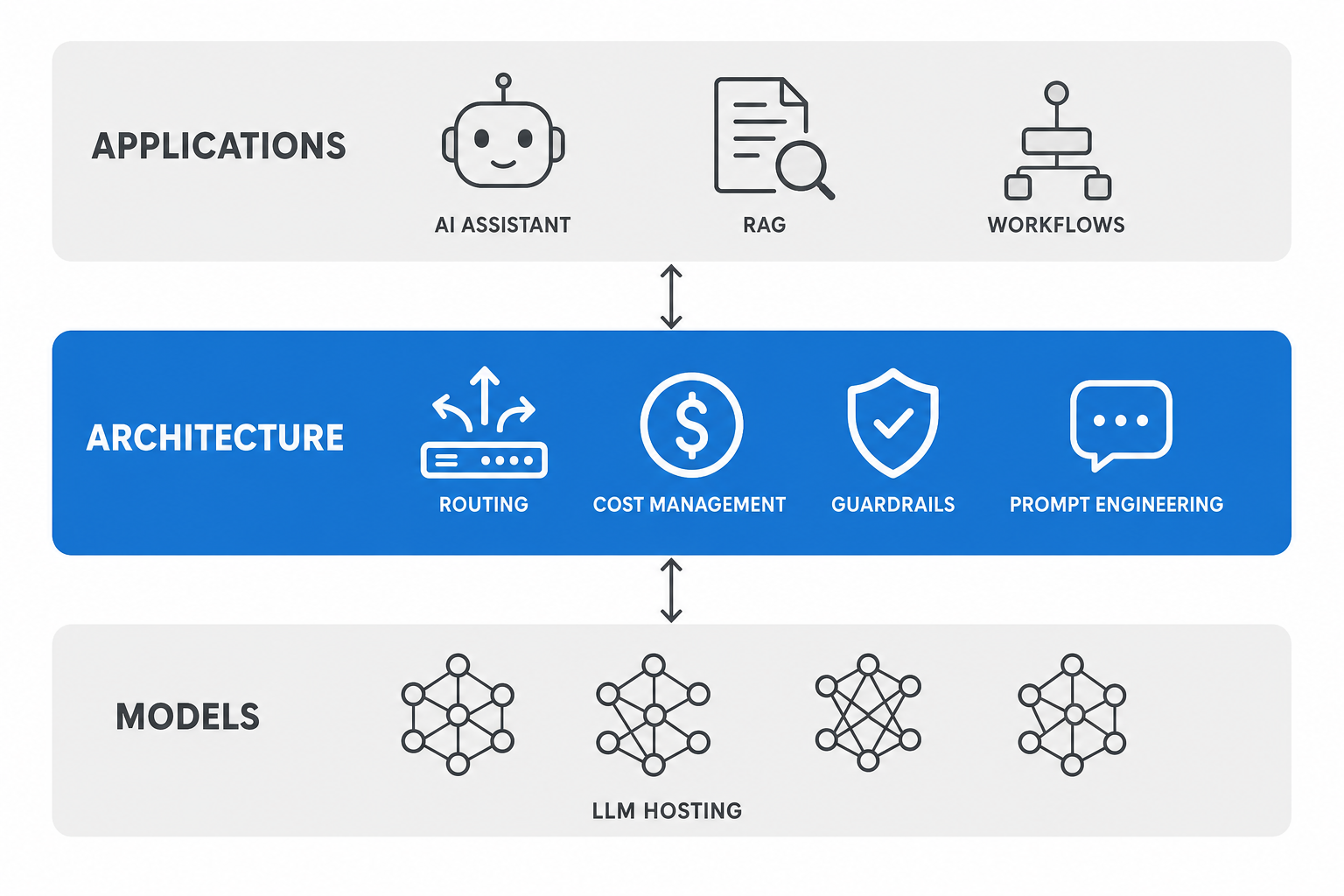
Where LLM Architecture Fits in the Stack
LLM architecture sits in the middle of a three-layer model:
| Layer | What it covers | Related Area |
|---|---|---|
| Models | Runtimes, serving, GPU setup | LLM Hosting · LLM Performance |
| Architecture | Routing, cost, guardrails, orchestration | You are here |
| Applications | AI assistants, RAG pipelines, agents | AI Systems · RAG |
The architecture layer is often skipped early on. It becomes essential when you have more than one model, more than one task type, or more than one user. Every architecture pattern in this cluster exists because “one model for everything” stopped working.
Cluster Map
The five topics in this cluster build on each other. Read in this order for the most logical path:
- You are here — this pillar: what LLM architecture is, how the pieces fit together
- Prompts — Writing Effective Prompts for LLMs — the foundation: shaping what the model receives
- Routing — Model Routing Strategies — the dispatcher: which model handles what
- Cost — Cost Optimization for LLM Systems — token budgeting, caching, local vs API economics
- Safety — LLM Guardrails in Practice — input validation, output filtering, compliance
- Orchestration — Multi-Model System Design — sequential, parallel, hierarchical, ensemble patterns
If you only have time for one, start with routing. It is the decision point where architecture begins.
Prompt Engineering
Prompt engineering is the closest layer to the model. Before routing, before caching, before guardrails — there is the prompt. What you send to the model determines what you get back.
The practical techniques that matter:
- Clarity and structure — clear instructions outperform clever framing
- Specific examples — few-shot examples anchor model behavior
- Role assignment — role-based prompts sharpen tone and constraint
- Varied approaches — different formats expose what the model responds to
- Context management — what you include shapes what the model weighs
Prompt engineering is not a one-time task. It is an ongoing calibration between your task requirements and the model’s behavior.
Deep dive:
- Writing Effective Prompts for LLMs — practical techniques for language model performance
Model Routing
A routing layer decides which model handles which request. Without it, every request goes to the same model — often too large for simple tasks, too small for complex ones.
Four routing strategies cover most production cases:
| Strategy | Optimize for | Best when |
|---|---|---|
| Capability-based | Task quality | Mixed complexity workloads |
| Cost-aware | Token spend | Budget-constrained systems |
| Latency-aware | Response time | Interactive tools and real-time chat |
| Hybrid | All three | Production systems with real constraints |
A fallback chain handles failures: order models from best to most reliable, ending with a local model that can’t be rate-limited or shut down by an API outage.
Deep dive:
- Model Routing Strategies: Local vs API, Cost-Aware, Latency-Aware — capability-based, cost-aware, and latency-aware routing with Python code
Cost Optimization
LLM costs scale linearly with usage. The strategies that actually reduce the bill:
Token budgeting sets per-session, per-task, or adaptive limits. Adaptive budgets track real usage and tighten allocations over time.
Local inference changes the cost structure entirely. After hardware amortization, local models run at electricity cost. A GPU at moderate usage pays for itself in months.
Caching is the most underrated optimization. Exact-match caching catches repeated prompts. Semantic caching catches prompts that mean the same thing. For high-traffic systems, semantic caching eliminates a large share of API calls before they happen.
Fallback chains reduce average cost per request: prefer expensive models when budget allows, fall back to cheaper or local ones as the session progresses.
Deep dive:
- Cost Optimization for LLM Systems: Token Budgeting, Fallback Models, Caching — real hardware numbers, break-even tables, and working Python patterns
Guardrails
LLMs are unpredictable by default. Guardrails constrain what goes in and what comes out — without removing model capability.
Three guardrail layers matter in practice:
Input validation stops problems before they reach the model. Prompt sanitization catches injection attempts. Length limits prevent token waste. Content filters block policy violations before inference costs anything.
Output filtering catches problems after generation. Structural validation ensures expected response shapes. Content checks block harmful outputs. Fact-checking (for critical domains) validates claims against a knowledge base.
Safety mechanisms protect the system over time: rate limiting prevents abuse, token budgets cap per-request costs, context window management prevents overflow and data leakage across turns.
For compliance-heavy systems (GDPR, HIPAA, SOC 2), add audit logging with structured, append-only entries and data residency controls.
Guardrails handle the model conversation, but once agents call tools and delegate work to other agents, a second security layer becomes necessary: who may act, on whose behalf, and with what audit trail. That is protocol security rather than model I/O filtering.
Deep dives:
- LLM Guardrails in Practice: Input Validation, Output Filtering, Safety — practical guardrail patterns and compliance notes
- A2A and MCP Agent Security: Identity, Delegation, and Audit Trails — agent protocol security beyond prompt safety: identity, authorization, gateways, and delegation controls
Multi-Model System Design
When a single model is not enough, the architecture question is: how do you orchestrate multiple models without creating complexity that costs more than it saves?
Five patterns cover the space:
| Pattern | Latency | Cost | Quality | Use when |
|---|---|---|---|---|
| Single Model | Lowest | Lowest | Variable | Prototyping, uniform workloads |
| Sequential (Pipeline) | High | Medium | High | Multi-step workflows with specialization |
| Parallel (Fan-Out) | Low | High | High | Independent tasks, A/B testing |
| Hierarchical (Planner-Executor) | High | High | Highest | Complex reasoning with specialist execution |
| Ensemble | Medium | Highest | Highest | Critical decisions requiring consensus |
The rule of thumb: start with the simplest pattern that handles your actual constraints. Most production systems reach parallel or hierarchical only after capability-based routing alone stops being enough.
Deep dive:
- Multi-Model System Design: When to Use Which Model and Why — all five patterns with working Python code and tradeoff tables
Architecture Decision Framework
Use this as a quick triage for what to add and when:
| Problem | Solution | When to add it |
|---|---|---|
| Bill is too high | Cost-aware routing, caching, local inference | When API costs become a real budget line |
| Latency is too high | Latency-aware routing, smaller models | When users notice slowness |
| Quality is inconsistent | Capability-based routing, fallback chain | When simple tasks get expensive models or complex tasks get cheap ones |
| Users are abusing the system | Input validation, rate limiting | When you open access beyond a trusted team |
| Responses are unsafe or off-policy | Output filtering, content guardrails | When you serve general users |
| One model handles everything | Multi-model design | When workloads diverge enough to warrant the complexity |
| Prompts are not working | Prompt engineering iteration | Always — prompts need tuning as tasks evolve |
Build architecture bottom-up. Prompt engineering is always in scope. Add routing when the cost/quality tradeoffs become real. Add guardrails when you serve external users. Add multi-model orchestration last.
How LLM Architecture Related to the other topics
LLM architecture sits at the intersection of several related clusters:
Infrastructure (below this layer):
- LLM Hosting in 2026: Local, Self-Hosted and Cloud Infrastructure Compared — runtimes (Ollama, llama.cpp, vLLM), hardware, and serving decisions. Architecture patterns depend on what infrastructure is available. Cost-aware routing only makes sense if you have both local and API models running.
- LLM Performance in 2026: Benchmarks, Bottlenecks and Optimization — latency numbers, VRAM limits, throughput measurements. These are the empirical inputs to routing and model selection decisions.
Application layers (above this layer):
- AI Systems: Self-Hosted Assistants, RAG, and Local Infrastructure — the systems that consume routing, guardrails, and orchestration decisions. Multi-model architecture is a prerequisite for production AI assistants.
- Retrieval-Augmented Generation (RAG) Tutorial — RAG is itself an architectural pattern: a retrieval pipeline feeding context into an LLM. The routing, cost, and guardrail patterns from this cluster apply inside RAG pipelines too.
Operational layer:
- Observability: Monitoring, Metrics, Prometheus and Grafana Guide — production LLM architecture needs observability. Cost tracking, latency monitoring, and guardrail violation metrics all require instrumentation at the architecture layer, not just the infrastructure layer.
