AI for Knowledge Management: Real Workflows That Hold Up
AI changes knowledge management, not its purpose.
AI is not replacing knowledge management; it is changing the shape of it for both individuals and teams.
Microsoft’s Work Trend Index describes a move toward hybrid teams of humans and agents, and NIST’s AI RMF argues that trustworthy AI systems need explicit roles, evaluation, and oversight rather than vague automation. Those ideas fit neatly beside the human-centred practices in the site’s Knowledge Management in 2026 pillar, which focuses on tools and methods long before any model is involved.
That is exactly the right frame for knowledge work: AI is best treated as an enrichment layer over notes, docs, runbooks, and research, not as a magical second brain that works without structure. A useful mental model is the one developed in PKM vs RAG vs Wiki vs Memory Systems, where human note systems, shared wikis, retrieval pipelines, and agent memory each play a distinct role instead of collapsing into a single tool.
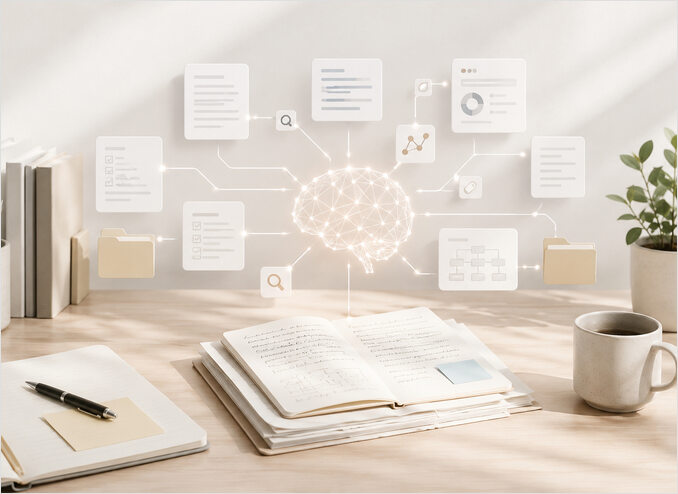
The slightly opinionated version is this: if your notes are chaotic, AI will not rescue them. It will often make the chaos more fluent. Good knowledge management still starts with capture, naming, ownership, and source discipline. What AI changes is what you can do after capture: compress, extract, link, retrieve, and repackage information at useful speed. That view fits both modern prompting guidance, which recommends small, well-scoped tasks, and chunking guidance that preserves semantic units for retrieval instead of flattening everything into one blob.
Why AI changes knowledge management
The core shift is from static archives to active memory. Embeddings convert text into vectors that reflect relatedness and are commonly used for search, clustering, and recommendations. Retrieval systems can then surface semantically similar material even when the query shares few or no keywords with the source text. In practical terms, that means a note about “incident review” can still find a runbook chunk titled “post-deployment outage steps” without brittle exact-match rules.
This is why AI-augmented knowledge management is worth doing now. The enabling pieces are no longer exotic: embedding APIs are mainstream, vector stores are standard, local embedding models are easy to run, and production databases such as Postgres can do both exact and approximate nearest-neighbour search with pgvector. The result is not artificial knowledge in the philosophical sense. It is a much more practical thing: better recall, better compression, and better context at the moment someone needs to think, especially when paired with solid representation choices from work such as Retrieval vs Representation in Knowledge Systems. If your next step is implementation detail, the RAG cluster covers chunking, retrieval, reranking, and production patterns in depth.
Workflow patterns that actually work
The patterns that hold up in production are boring in the best way. They use AI for bounded transformations, not vague autonomy. In practice, three patterns show up again and again: summarisation, extraction, and linking suggestions. Those map neatly to what current tools do well: summarise within a clear scope, extract structured data with schemas, and compute semantic relatedness through embeddings and retrieval. They also map cleanly onto the layered view of knowledge systems behind concepts such as second brain workflows and LLM Wiki style compiled knowledge.
Summaries that preserve decisions
Summarisation works best when it stays close to the source and preserves the parts humans actually need later: decisions, unresolved questions, owners, dates, and links back to the original material. For software teams, this maps naturally onto Architecture and Product Decision Records — a lightweight docs-as-code practice that keeps the rationale behind technical and product choices versioned alongside the code. OpenAI’s enterprise prompting guidance explicitly recommends “one prompt, one deliverable”, simple headings, and clear success criteria. That is a good discipline for knowledge work too: summarise one meeting, one document, or one research item at a time, then store the summary beside the source. Do not ask a model to “summarise my knowledge base” and expect anything trustworthy.
A real workflow looks like this: capture meeting notes or a PDF, run a scoped summary prompt, store the summary with source references, then add a human check before it becomes canonical. If the source is a rich PDF, multimodal parsing can matter because slide decks and exported web pages often contain layout cues that plain text extraction misses. OpenAI’s PDF parsing cookbook shows a practical split between text extraction and page-image analysis for turning rich PDFs into retrievable content.
# Context
You are assisting with team knowledge capture.

# Instructions
Summarise this meeting note in:
- 5 key points
- decisions made
- open questions
- actions with owners
- terms that should link to existing notes

# Constraints
- Do not invent details
- If something is unclear, mark it as uncertain
- Include the source note ID
Extraction that creates reusable fields
Extraction is where AI starts to feel genuinely infrastructural. Instead of storing only prose, you ask the model to populate reusable fields such as entities, systems, APIs, owners, action items, products, dates, claims, or risk tags. OpenAI’s Structured Outputs feature is designed to keep responses aligned to a JSON Schema, and Ollama offers the same pattern locally with schema-based JSON output. That matters because useful knowledge systems are made of fields you can sort, filter, compare, and validate, not just paragraphs that sound clever.
OpenAI’s long-document entity extraction example follows the right operational pattern: chunk the document, extract the relevant facts from each chunk, and then combine results. That same workflow works for postmortems, research papers, product docs, customer interviews, and support transcripts. In practice, I would extract more than named entities: I would also pull “needs follow-up”, “contradicts existing note”, and “candidate for evergreen note” because those fields create action, not just metadata.
{
  "source_id": "note-2026-05-22-incident-review",
  "summary": "Short summary here.",
  "entities": ["service-a", "postgres", "oauth"],
  "actions": [
    {"owner": "ops", "task": "rotate keys", "due": "2026-05-24"}
  ],
  "related_terms": ["token refresh", "deployment checklist"],
  "confidence": "medium"
}
Linking that turns notes into a graph
Link suggestions are the quiet workhorse of AI for knowledge management. Embeddings are explicitly used for search, clustering, and recommendations, which makes them a natural fit for related notes, similar incidents, see also, and you may want to merge these two docs features. Semantic retrieval is especially good at surfacing conceptually related content even when wording differs. That makes it far better than folder hierarchies alone for large note sets and technical documentation.
Dense semantic search should not be your only retrieval signal, though. Exact identifiers still matter: function names, package names, issue IDs, error codes, SKUs, regulation numbers. Google Research has shown that hybrid retrieval, which combines semantic and lexical signals, improves recall because each method finds relevant material the other misses. In a technical knowledge base, that is not an academic detail. It is the difference between finding the conceptually related design note and also finding the exact migration command someone needs at 2 a.m.
If you are already on Postgres, pgvector is the pragmatic option. It stores vectors with the rest of your data, supports exact search by default, and offers approximate indexing through HNSW and IVFFlat when you need more speed and can tolerate some recall trade-off. That is enough to build related-content suggestions, semantic search, and note deduplication without adding a separate vector database on day one.
The human plus AI loop
The model that actually works is not human or AI. It is capture -> AI enrich -> human refine. Microsoft describes the broader shift as humans working with assistants and then agent teams, while NIST’s AI RMF and Playbook stress clearly defined human roles, responsibilities, and oversight in human-AI configurations. For knowledge management, that means humans remain accountable for the canonical note, the source of truth, and the final merge or publication decision. AI does the first-pass compression and cross-linking; humans do the judgement.
capture -> parse -> chunk -> embed -> enrich -> review -> publish
             |         |        |
             |         |        +-> related notes
             |         +-> retrieval index
             +-> structure-aware extraction
This division of labour is more than cautious process design. It matches how risk accumulates. NIST notes that understanding the limitations of human-AI interaction improves AI risk management, and that roles in oversight and use should be clearly differentiated. In practice, that means the model can draft titles, tags, summaries, and candidate links, but a person should approve anything that changes taxonomy, publishes external content, or overwrites an existing note. If you let the model silently rewrite your knowledge base, you are not building memory. You are outsourcing editorial control to a probabilistic system.
The tool choices that matter
The base layer is embeddings plus retrieval. OpenAI’s embeddings guide frames embeddings as a way to measure relatedness between text strings, while the Retrieval API handles semantic search over your data through vector stores. For many teams, that is the minimum viable stack for AI-augmented knowledge management: parse content, chunk it well, embed it, and retrieve the right fragments before synthesis. If you only do one serious thing this quarter, make it retrieval-backed recall instead of a chat wrapper over raw documents.
Local models are the right answer when privacy, offline use, or cost control dominate. Ollama documents both local embeddings and structured outputs, and its product pages emphasise that data stays yours and that workloads can run entirely offline. That makes local-first pipelines sensible for internal notes, engineering runbooks, and sensitive research archives. My bias is simple: use local models for indexing, classification, and routine enrichment; reach for hosted APIs when you need stronger reasoning, multimodal extraction, or the best available model quality.
Do not ignore parsing and chunking. Unstructured’s chunking docs recommend building chunks from semantic document elements rather than raw character boundaries when possible, and OpenAI’s PDF cookbook shows why rich-document parsing matters for RAG. Structure-aware PDF work goes further: naive parsing can destroy tables, scramble reading order, and strip hierarchical headings, while structure-aware parsing preserves paragraphs, tables, and document hierarchy. In knowledge management, that is the difference between an index that understands your corpus and one that merely tokenises it.
Limitations worth respecting
Hallucination is still the obvious risk, but the more useful framing is insufficient context. RAG exists because large language models can hallucinate, use stale knowledge, and produce answers with weak traceability; retrieval helps by grounding generation in external knowledge. Even so, Google Research found that models often answer incorrectly instead of abstaining when the provided context is not sufficient. That matters for knowledge management because “I found something similar” is not the same as “I found enough to answer”. Your system should preserve source references, expose uncertainty, and prefer abstention over confident fabrication.
Long context does not remove the need for retrieval discipline. The 2023 “Lost in the Middle” paper showed that model performance could degrade when relevant information sat in the middle of long inputs, and newer Google results show that at least some newer models have improved substantially on simple needle-in-a-haystack retrieval near context limits. The sober lesson is not “long context solves it” or “long context is useless”. It is that you should test your actual workflows and corpus, because position effects, task type, and document structure still matter.
Loss of structure is the quieter failure mode, and in technical documentation it can be worse than hallucination because it poisons retrieval before the model even starts reasoning. Structure-aware PDF research shows that naive parsing can split tables, destroy their internal meaning, and break reading order, while semantic chunking systems try to preserve coherent document elements. If your source material includes tables, diagrams, code examples, or multi-column layouts, your parser is part of your knowledge system, not a boring preprocessing detail.
So the practical rule is this: keep the human editorial loop, preserve source links, use schemas for extraction, and treat retrieval quality as a product feature. AI does not replace PKM, team docs, or knowledge architecture. It changes the leverage. Used well, it turns raw notes into searchable, linkable, structured memory. Used badly, it turns your documentation into high-speed drift — the same drift that LLM Wiki Maintenance: Drift, Contradictions and Review walks through with concrete detection and review workflows.
