
GPUs for AI in 2026: NVIDIA, AMD, Intel Compared
AI GPU comparison across three vendors
The AI hardware landscape has shifted significantly in 2026, with NVIDIA, AMD, and Intel all competing for developers who need GPUs capable of running local large language models and AI inference workloads.
Choosing the right GPU for AI workloads requires looking beyond marketing numbers and focusing on the specifications that actually affect real-world performance. Memory capacity, memory bandwidth, and software ecosystem maturity consistently matter more than theoretical compute peaks when running transformer models locally.
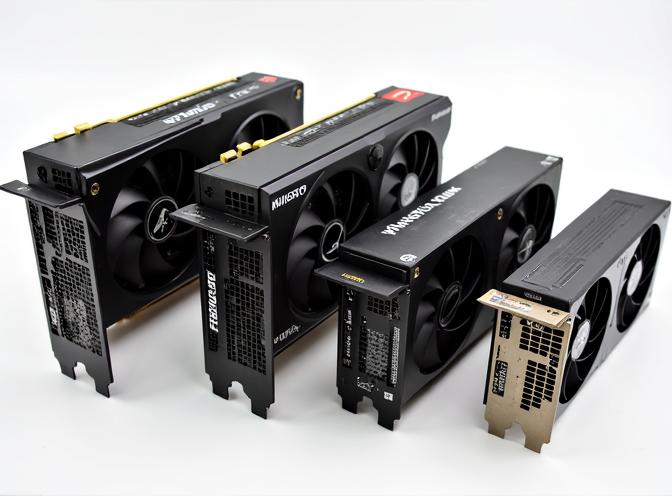
This comparison covers the most relevant workstation and prosumer GPUs available in mid-2026, including NVIDIA’s Blackwell architecture (RTX 50-series), AMD’s Radeon AI Pro R9700, and Intel’s Arc Pro B70. The goal is to provide a practical reference for developers deciding which hardware best fits their model sizes, software stack, and budget constraints.
Which GPU specifications matter for AI workloads
Marketing materials from GPU vendors emphasise AI TOPS and tensor performance, but these metrics rarely tell the complete story for local inference. The specifications below are ranked by their actual impact on running large language models.
VRAM capacity
VRAM is typically the first limiting factor when running LLMs locally. A model cannot execute entirely on the GPU if it does not fit into available memory. Once model weights spill into system RAM, inference performance drops dramatically.
Approximate VRAM requirements for common model sizes:
| Model Size | Recommended VRAM |
|---|---|
| 7B | 8-12 GB |
| 14B | 16 GB |
| 32B | 24-32 GB |
| 70B | 48-64 GB |
| 120B+ | Multiple GPUs |
For most homelab users, moving from 16 GB to 32 GB of VRAM provides a substantially larger practical benefit than increasing raw compute performance. A 32 GB GPU capable of running an entire model will often outperform a theoretically faster 16 GB GPU forced to offload tensors into system memory.
Memory bandwidth
Memory bandwidth determines how quickly model weights can be streamed into compute units. Large transformer models continuously move massive amounts of data between VRAM and processing cores during inference.
As models grow, bandwidth often becomes the dominant performance bottleneck. A card with higher bandwidth can outperform another GPU with significantly higher theoretical compute performance, particularly during prompt processing phases where the model reads through the entire context window.
FP32 compute
FP32 throughput remains useful for scientific computing, simulation, rendering, and some AI preprocessing workloads. Modern inference engines rarely execute entirely in FP32 precision, relying instead on quantised formats like Q4_K_M or Q8_0. FP32 should be considered a secondary metric for AI inference.
AI TOPS and tensor performance
Every GPU vendor promotes AI TOPS as a headline number. These values are not directly comparable across vendors. NVIDIA, AMD, and Intel measure AI throughput differently, use different tensor hardware, and apply different assumptions regarding sparsity and numerical precision.
AI TOPS should be viewed as an indication of peak theoretical capability rather than an expected LLM inference speed. Real-world token generation rates depend on model architecture, quantisation level, context length, and software optimisation — factors that TOPS numbers do not capture.
Software ecosystem maturity
Software support often determines whether hardware reaches its full potential. The current ecosystem landscape is approximately:
| Vendor | Primary AI Stack | Maturity |
|---|---|---|
| NVIDIA | CUDA, TensorRT | Industry standard |
| AMD | ROCm, HIP, Vulkan | Solid for PyTorch, llama.cpp, Ollama |
| Intel | oneAPI, SYCL, OpenVINO | Improving rapidly, trailing peers |
CUDA remains the industry standard with the broadest library support. ROCm has matured significantly over the past two years and now provides a functional experience for PyTorch, llama.cpp, and Ollama on Linux. Intel’s oneAPI ecosystem continues to improve but still trails both NVIDIA and AMD in overall software maturity and community adoption.
For a deeper look at NVIDIA-specific GPU analysis, see Comparing NVIDIA GPU Suitability for AI. Once you’ve picked an AMD card, the next decision is which of ROCm and Vulkan to run it with per engine — ROCm vs Vulkan for AMD Local LLM Hosting covers that software-side follow-up decision engine by engine.
Complete GPU comparison table
The table below compares the most relevant workstation and enthusiast GPUs for AI workloads in 2026.
| GPU | VRAM | Bandwidth | FP32 (TFLOPS) | AI TOPS (INT8) | TBP | MSRP |
|---|---|---|---|---|---|---|
| NVIDIA RTX 5090 | 32 GB | 1792 GB/s | 104.6 | 3352 | 575 W | $1999 |
| NVIDIA RTX 5080 | 16 GB | 960 GB/s | 56.3 | 1801 | 360 W | $999 |
| NVIDIA RTX 5070 Ti | 16 GB | 896 GB/s | 43.9 | 1406 | 300 W | $649 |
| NVIDIA RTX 5070 | 12 GB | 672 GB/s | 30.9 | 494 | 250 W | $549 |
| NVIDIA RTX 5060 Ti 16GB | 16 GB | 448 GB/s | 23.7 | 614 | 180 W | $399 |
| NVIDIA RTX PRO 6000 | 96 GB | 1792 GB/s | 125.0 | 4000 | 600 W | $4999 |
| NVIDIA RTX PRO 5000 | 48 GB | 1344 GB/s | 73.7 | 2064 | 300 W | $2499 |
| NVIDIA RTX PRO 4500 | 32 GB | 896 GB/s | 54.9 | 1577 | 200 W | $2500 |
| NVIDIA RTX PRO 4000 | 24 GB | 672 GB/s | 46.9 | 1178 | 145 W | $1500 |
| NVIDIA RTX PRO 4000 SFF | 24 GB | 432 GB/s | 46.9 | 770 | 125 W | $1500 |
| NVIDIA RTX PRO 2000 | 16 GB | 288 GB/s | 18.4 | 592 | 70 W | $700 |
| AMD Radeon AI Pro R9700 | 32 GB | 640 GB/s | 47.8 | 766 | 300 W | $1299 |
| Intel Arc Pro B70 | 32 GB | 608 GB/s | 22.94 | 367 | 230 W | $949 |
These prices are MSRP, don’t expect to find the NVIDIA RTX 5090 at this price, expect something like $4300+, and Intel Arc Pro B70 IRL would be close to $1100.
Key observations by segment
Consumer GPUs
The RTX 5090 remains the fastest single-GPU solution for local AI development, combining exceptional memory bandwidth with the mature CUDA ecosystem. For users running large quantised models, it currently represents the highest-performance consumer option.
The RTX 5080 and RTX 5070 Ti both offer 16 GB of VRAM, which is sufficient for most 7B-14B models but limits you when working with larger checkpoints. The RTX 5060 Ti 16GB variant is an interesting budget option — 16 GB of VRAM at $399 is compelling for entry-level AI workloads, though the narrower memory bus will impact throughput.
Workstation GPUs
Within the workstation segment, AMD’s Radeon AI Pro R9700 occupies an attractive middle ground. It delivers 32 GB of VRAM, competitive memory bandwidth, and a significantly lower purchase price than NVIDIA’s professional offerings. For developers already comfortable with ROCm on Linux, it provides one of the strongest value propositions in 2026.
Intel’s Arc Pro B70 is particularly interesting because of its pricing. Although it offers lower compute performance than both NVIDIA and AMD, it provides the same 32 GB memory capacity while consuming less power. For users building cost-effective multi-GPU inference servers, the B70 deserves consideration — especially if the oneAPI ecosystem meets your software requirements.
Professional GPUs
NVIDIA’s RTX PRO series dominates the professional segment, with the RTX PRO 6000 offering 96 GB of VRAM — unmatched by any competitor. For teams running very large models or multiple concurrent inference workloads, the RTX PRO 6000 and RTX PRO 5000 remain the safest choices, though at a premium price.
For a real-world performance comparison across different hardware platforms, see NVIDIA DGX Spark vs Mac Studio vs RTX-4080.
Practical hardware considerations
Physical dimensions and form factor
GPU size varies significantly across product lines and affects compatibility with your case and cooling solution.
| GPU | Approx. Length | Slots | Cooler Type |
|---|---|---|---|
| RTX 5090 | 333 mm | 2.7× | Triple-fan, blower or open |
| RTX 5080 | 303 mm | 2.5× | Dual/triple-fan |
| RTX 5070 Ti | 280 mm | 2.4× | Dual-fan |
| RTX 5070 | 245 mm | 2.1× | Dual-fan |
| RTX 5060 Ti | 200 mm | 1.8× | Dual-fan |
| AMD R9700 | 300 mm | 2.5× | Dual-fan |
| Intel Arc Pro B70 | 267 mm | 2.1× | Single/dual-fan |
| RTX PRO 6000 | 438 mm | 3.5× | Blower, full-height |
| RTX PRO 5000 | 438 mm | 3.5× | Blower, full-height |
| RTX PRO 4000 | 267 mm | 2.1× | Blower, low-profile option |
| RTX PRO 4000 SFF | 178 mm | 1.5× | Blower, half-height |
The RTX PRO 6000 and 5000 are significantly longer than consumer cards and require full-height tower cases. The RTX PRO 4000 SFF is one of the few GPUs under 180 mm, making it suitable for compact workstation builds and rack-mounted servers.
Consumer GPUs (RTX 50-series) use open-air coolers that exhaust heat into the case — adequate case airflow is essential. Workstation GPUs use blower-style coolers that exhaust heat directly out the rear, which is better for multi-GPU configurations and enclosed server environments.
Power delivery and PSU requirements
TBP (Total Board Power) is the GPU’s maximum power draw, but actual system requirements depend on transient spikes and CPU overhead.
| GPU | TBP | Recommended PSU | Power Connectors |
|---|---|---|---|
| RTX 5090 | 575 W | 1000 W+ | 12V-2x6 (20-pin) |
| RTX 5080 | 360 W | 750 W | 12V-2x6 |
| RTX 5070 Ti | 300 W | 650 W | 8-pin + 8-pin |
| RTX 5070 | 250 W | 600 W | 8-pin |
| RTX 5060 Ti | 180 W | 550 W | 8-pin |
| AMD R9700 | 300 W | 650 W | 8-pin + 8-pin |
| Intel Arc Pro B70 | 230 W | 550 W | 8-pin |
| RTX PRO 6000 | 600 W | 1000 W+ | 12V-2x6 |
| RTX PRO 5000 | 300 W | 650 W | 8-pin + 8-pin |
| RTX PRO 4000 | 145 W | 500 W | 8-pin |
| RTX PRO 4000 SFF | 125 W | 450 W | 8-pin |
| RTX PRO 2000 | 70 W | 400 W | PCIe slot only |
The RTX 5090 and RTX PRO 6000 both exceed 575W TBP and require the newer 12V-2x6 connector (20-pin). Ensure your PSU supports this connector natively — adapter cables from multiple 8-pin connectors are not recommended for cards above 450W due to transient power spikes that can exceed rated capacity momentarily.
Thermal characteristics and sustained workloads
AI inference workloads keep the GPU under sustained load, unlike gaming which has variable utilisation. This affects thermal behaviour significantly.
- RTX 5090 at 575W: Expect GPU temperatures of 72-78°C under sustained inference. The higher TBP means more heat dissipation is required — a case with positive static pressure and quality filters is recommended.
- RTX 5080 at 360W: Runs cooler, typically 65-72°C. More manageable for standard mid-tower cases.
- Workstation GPUs (blower): RTX PRO series exhaust heat directly out the case, keeping case temperatures lower. GPU temperatures may read higher (75-82°C) but this is by design — the blower cooler trades GPU temperature for lower case temperature.
- Low-power options: RTX PRO 2000 at 70W and RTX PRO 4000 SFF at 125W are suitable for passive or low-fan-speed cooling, making them ideal for always-on inference servers where noise matters.
For multi-GPU setups, blower-style coolers (workstation GPUs) are strongly preferred over open-air consumer coolers, as the second GPU would otherwise pull hot air from the first.
PCIe lanes and bandwidth
GPU performance can be limited by PCIe lane count. A GPU plugged into a x8 or x4 slot will experience reduced memory bandwidth compared to a full x16 connection. For multi-GPU setups, understand how PCIe lanes are distributed across your motherboard. See LLM Performance and PCIe Lanes for detailed analysis.
Multi-GPU setups
When a single GPU cannot fit your model, multi-GPU configurations become necessary. NVIDIA NVLink (where supported) and PCIe-based model parallelism are the primary approaches. The AI Infrastructure on Consumer Hardware guide covers multi-GPU deployment strategies in depth.
Note that AMD and Intel GPUs have limited multi-GPU inference support in most frameworks. If you plan to scale with multiple GPUs, NVIDIA is currently the only practical option.
Conclusion
There is no universally best GPU for AI workloads. The right choice depends on your software stack, budget, and the size of the models you intend to run.
NVIDIA’s Blackwell family remains the benchmark for inference performance, thanks to outstanding memory bandwidth and the maturity of CUDA and TensorRT. AMD’s Radeon AI Pro R9700 has established itself as a compelling workstation option, offering an excellent balance between price, memory capacity, and compute performance. Intel’s Arc Pro B70 proves that affordable 32 GB workstation GPUs are now a reality, though its software ecosystem continues to mature.
The most important lesson from 2026 is that AI hardware should no longer be evaluated using gaming benchmarks. For modern LLM inference, VRAM capacity, memory bandwidth, and software support consistently have a greater impact on real-world performance than theoretical AI TOPS alone.
References
- Comparing NVIDIA GPU Suitability for AI — NVIDIA-specific GPU analysis with detailed CUDA core and tensor core comparisons
- AI Infrastructure on Consumer Hardware — Full-stack guide to deploying self-hosted AI with consumer GPUs
- NVIDIA DGX Spark vs Mac Studio vs RTX-4080 — Real-world Ollama performance benchmarks across hardware platforms
- LLM Performance and PCIe Lanes — How PCIe configuration affects LLM inference performance
- Ollama Cheatsheet — Command reference and tips for Ollama model serving
- Quadro RTX 5880 Ada Review — Review of the 48GB workstation GPU alternative
- Best LLM on 16 GB VRAM GPU — llama.cpp benchmarks for models on 16 GB VRAM
