Second Brain Explained for Engineers and Knowledge Workers
Notes are storage. A second brain is computation.
Information overload is less about sheer volume than about unresolved inputs. Modern knowledge work leaves a trail of tabs, chat threads, docs, highlights, snippets, transcripts, screenshots, and half-written notes.
Most of that material is only potentially useful, because almost none of it surfaces at the moment it would actually help. That gap between capture and reuse is where the idea of a second brain becomes interesting.
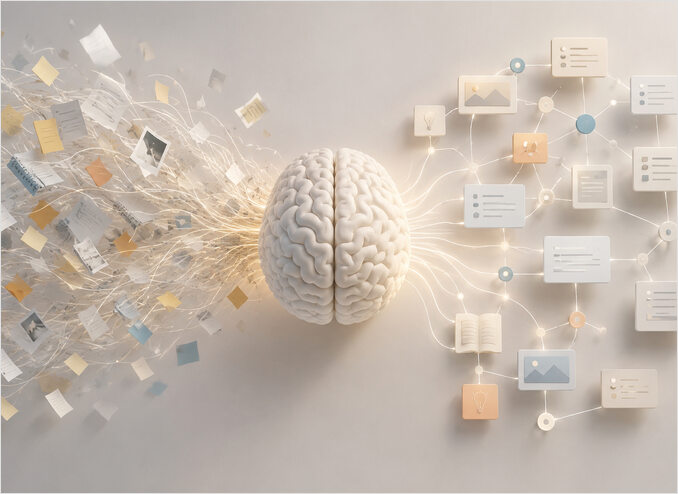
In contemporary personal knowledge management, Tiago Forte popularized the term second brain for an external digital repository of ideas, insights, and resources. The phrase can sound inflated, yet the useful core is practical. A second brain externalizes thinking so your biological brain spends less energy on storage and more on interpretation, connection, and output.
The site’s Knowledge Management in 2026 hub gathers adjacent guides—tools, self-hosted wikis, and PKM methods—when you want surrounding context beyond this article, and AI for Knowledge Management: Real Workflows That Hold Up shows how summarisation, extraction, and semantic linking pipelines can sit on top of a second brain rather than attempt to replace it.
Philosophically, the idea is less exotic than the branding implies. External media have always extended cognition—a notebook, a diagram, a link map, or a markdown vault can sit inside the thinking loop. A second brain is that familiar pattern updated for search, backlinks, linked notes, and AI-assisted retrieval.
What Is a Second Brain
A second brain is an external knowledge system, but that label alone is too weak. Plenty of systems store information; a genuine second brain also helps you retrieve, compare, compress, and reuse ideas.
That is why a second brain is not merely a note-taking app. Apps hold text; a second brain sustains a loop between capture and expression. When someone asks what a second brain is, the shortest honest answer is that it is a personal system for turning scattered inputs into reusable thinking.
The contrast between notes and a knowledge system matters because notes are inert artifacts. A knowledge system gives those artifacts retrieval paths, relationships, and context. A folder full of markdown files is no more a second brain than a pile of source files is a finished product—structure and flow are the missing layers.
The strongest setups therefore resist obsession with storage. Storage is cheap, retrieval is expensive, and synthesis is where value compounds. If the system cannot help turn yesterday’s reading into tomorrow’s writing, design, research, or decision-making, it behaves less like a brain and more like a basement. The plumbing that keeps those files consistent across a desktop, laptop, and home server also matters; Syncthing File Sync for Self-Hosted Knowledge Systems covers that private, peer-to-peer layer without pulling your second brain into a cloud subscription.
Core Principles of a Second Brain
The most useful modern framing is CODE—Capture, Organize, Distill, Express. The acronym sounds simple because it is simple, which is part of its power.
Capture
Capture does not mean saving everything; that path leads quickly to digital hoarding. Good capture means saving ideas with future energy. Useful notes tend to be surprising, reusable, unresolved, emotional, or clearly tied to active work.
Accordingly, the capture question is rarely “Should this be saved forever?” The sharper question is “Will this be useful again in a different context?” A second brain improves when it collects sparks rather than exhaust.
Organize
Organization is not about perfect taxonomy. It is about retrieval with low friction—making information easier to find while work is already in motion.
Here PARA often enters the conversation. Projects, Areas, Resources, and Archives offer a lightweight way to organize by actionability rather than abstract topic. Strict category trees often decay into maintenance work, whereas action-oriented buckets keep the system tethered to reality. The PARA method for engineers maps this concretely to engineering work — codebases, documentation, and the ongoing tension between active project notes and long-term reference material.
Distill
Distillation is where raw notes stop cluttering the vault and start becoming knowledge. A long highlight dump is not yet useful; a distilled note surfaces what is worth keeping, which claims deserve testing, and which ideas can be reused.
Many people skip this step, yet it is what makes the whole method work. Distillation turns large volumes of text into a smaller set of ideas you can recognize later without rereading everything from scratch. The writing practice that formalizes this step is evergreen notes — atomic, standalone notes written in your own words that improve when revisited rather than decaying into stale context.
Express
Expression is the phase most note-taking systems quietly avoid, but without output the loop never closes. A second brain earns its keep when notes become articles, designs, code comments, decision memos, architecture docs, or working theories.
Without output there is no pressure test, and without a pressure test there is no learning loop—so a second brain that never expresses anything is only a well-organized backlog.
Second Brain vs PKM
Personal knowledge management (PKM) names the wider field—the habits, skills, and systems people use to gather, evaluate, organize, retrieve, and apply what they learn. In academic literature PKM stretches beyond note-taking and software into cognitive, informational, social, and learning competencies. For a fuller tour of that field than this narrower framing allows, see Personal Knowledge Management — goals, methods, and tools.
A second brain sits inside that umbrella as one philosophy of PKM, especially the digital workflow built around capture, organization, distillation, and expression. In Tiago Forte’s framing, Building a Second Brain describes the larger creative process, while PARA is one implementation layer within it.
The terms are related but not interchangeable. PKM is the category; a second brain is an opinionated implementation—and many online debates about second-brain systems are really debates about the broader PKM problem wearing a narrower label.
Second Brain vs Wiki vs RAG
Technical readers usually arrive next at a pair of questions—how a second brain differs from a wiki, and how it differs from RAG—and the answer begins with intent.
| System | Primary job | Best at | Weak point |
|---|---|---|---|
| Second brain | Personal evolving context | Idea development and synthesis | Can become messy and highly personal |
| Wiki | Shared structured knowledge | Documentation and stable reference | Weaker for unfinished thinking |
| RAG | Query time retrieval for AI | Grounded responses over external sources | Does not preserve human interpretation by itself |
Wikis stabilize knowledge. They favor explicit structure, shared naming, and pages that converge toward a source of truth, which makes them excellent for documentation yet awkward for half-formed concepts, private context, and exploratory thinking. Self-hosted setups such as DokuWiki and its alternatives illustrate how teams turn that impulse into durable reference sites.
A second brain usually begins from the opposite posture—it is personal, evolving, and tolerant of ambiguity, existing before consensus settles. In that sense a wiki is where knowledge goes when it stops changing quickly, whereas a second brain is where it still changes shape.
RAG addresses yet another problem. Retrieval-augmented generation connects an AI model to external knowledge so responses can draw on fresher or more domain-specific context at query time. That capability is valuable, yet it is not the same as building a personal knowledge system—RAG retrieves at inference time, while a second brain remembers what mattered, why it mattered, and how your interpretation shifted.
The interesting technical point is complementarity. A second brain can feed a wiki; a wiki can supply a clean source for RAG; RAG can make a second brain easier to search. None of those roles makes the abstractions interchangeable. The production-oriented RAG tutorial spells out the machine-side retrieval stack; read alongside a personal vault, it clarifies what human-curated notes preserve that query-time retrieval alone does not. For a structured comparison of all four paradigms — PKM, wikis, RAG, and AI memory — in a single framework, PKM vs RAG vs Wiki vs Memory Systems maps their differences and real-world use cases.
Tools for a Second Brain
People gravitate to tool wars because tools are visible and structure is not, yet the tool is usually the least informative part of the system.
Obsidian
Obsidian appeals because it pairs local markdown files with internal links, backlinks, properties, and graph-style navigation—it feels like a knowledge base first and a text editor second. For technical users who care about file ownership and link-driven structure, that combination is hard to ignore. Vault-oriented setup detail lives in Using Obsidian for personal knowledge management. Many Obsidian users pair the tool with the Zettelkasten method; Zettelkasten for Developers covers how to adapt it specifically for software engineering work.
Logseq
Logseq speaks to a different instinct. It is local-first, privacy-oriented, and built around an outline model where daily journals, bullets, references, and nonlinear linking make the tool feel less like drafting documents and more like accumulating thought fragments that later connect.
Notion
Notion sits closer to docs, lightweight databases, and team wiki workflows, while still supporting links, backlinks, and increasingly AI-driven search and summarization across connected workspaces. For anyone who wants one surface for docs, projects, and knowledge hubs, the appeal is obvious.
Underneath those differences, all three can support a second brain—and all three can fail at it. Tool choice shifts ergonomics more than philosophy; a weak workflow inside a powerful tool stays weak, while a clear workflow inside a simpler tool still compounds. When Obsidian and Logseq are both on the table, Obsidian vs Logseq is the feature-level split readers usually want next.
Common Second Brain Mistakes
The first trap is collecting too much. Capture feels productive because it is frictionless, yet when everything seems worth saving, nothing stays salient. The usual outcome is a bloated archive with thin signal density.
The second trap is over-structuring, often driven by anxiety. Extra folders, tags, naming rules, and dashboards feel safer, but systems that demand constant grooming stop serving thinking and begin consuming it.
The third trap—both the most common and the most costly—is failing to express. Notes that never become output do not compound; they only accumulate. The promise of a second brain hinges on turning private fragments into public or practical artifacts.
How a Second Brain Evolves
Early on the system can look underwhelming—a handful of notes, a few saved links, perhaps a project page and some book highlights—and then the connections start.
A meeting note links to a design decision; a blog draft links to a half-finished idea from six months earlier; a research note links to a bug report, which links to a product discussion, which loops back to a concept that once seemed unrelated. That is when static notes begin behaving like a dynamic system.
Over time a second brain starts acting like a personal knowledge graph, which does not require a literal graph view. Value shifts from individual notes to relationships among them—the archive stops feeling like a cabinet of documents and starts feeling like a map of evolving context.
That shift drives compounding. Notes become connections, connections become reusable patterns, and reusable patterns cultivate judgment.
AI and the Second Brain
AI is the newest animating layer in this conversation, though not for the reason hype suggests. The payoff is not that AI replaces your second brain; it is that AI can make a human-centered second brain more capable. Readers routing notes toward assistants will find adjacent infrastructure context in AI systems—orchestration, retrieval, and memory beyond a single chat prompt.
In practice AI can fill three roles—summarizing large notes, transcripts, and documents; surfacing related ideas across a workspace faster than manual search; and augmenting expression through outlines, alternative framings, rough rewrites, or extracted action items.
Those abilities edge toward magic until they don’t. AI does not decide what deserves to matter inside your system; it predicts relevance from patterns. Meaning still flows from human priorities, context, and taste—which is why “Can AI improve a second brain without replacing human judgment?” lands on a clear yes only because the judgment layer stays human.
The strongest systems will probably braid both strands—human-curated notes supplying durable context, AI supplying acceleration through summarization, search, and transformation—so the model operates quickly over the archive without owning it. The architectural pattern that formalizes this is LLM Wiki: using LLMs to compile structured knowledge at ingest time so the system stops re-deriving the same synthesis from raw notes on every query.
Take Away
“Second brain” is slightly misleading branding. The aim is not to manufacture another brain; it is to stop treating your first one like cold storage.
A second brain is neither a single tool nor “just notes” nor a prettier folder tree. It is a system for capturing ideas, organizing them for retrieval, distilling them into reusable insight, and expressing them as work.
That is why the concept survives tool churn. Apps change, interfaces change, and AI changes faster than both, yet the underlying failure mode persists—knowledge work breaks when useful ideas vanish between the moment of capture and the moment of need. A second brain is one of the few frameworks that treats that gap as a design problem rather than a character flaw.
Useful links
To deepen your grasp of CODE and PARA, the philosophical idea of extended cognition, and the gap between human-centered notes and retrieval-first RAG, these readings are a practical next step:
-
Building a Second Brain overview — Tiago Forte’s canonical introduction—the naming of the idea, the CODE workflow (Capture, Organize, Distill, Express), and the case for externalized cognition beyond sheer storage.
-
PARA method — Practical organization by actionability rather than textbook taxonomy; especially helpful for thinking about retrieval friction versus folder perfectionism.
-
The extended mind — Andy Clark and David Chalmers’ paper on cognitive extension—why notebooks, diagrams, and digital notes can count as part of the thinking process, not just accessories to it.
-
Retrieval-augmented generation for knowledge-intensive NLP tasks — Lewis et al.’s foundational RAG paper; useful background for why RAG is built around query-time retrieval and differs in purpose from a curated personal vault.
-
What is retrieval-augmented generation? — A clear, implementation-minded explanation of RAG architecture and limits—good companion reading for the wiki versus second brain versus RAG comparison.
Bonus. Supersizing the mind — the science of cognitive extension — Forte connects extended-mind ideas to everyday knowledge work; a strong bridge between theory and practice.
