Structured Logging in Go with slog for Observability and Alerting
Queryable JSON logs that connect to traces.
Logs are a debugging interface you can still use when the system is on fire. The problem is that plain text logs age poorly: as soon as you need filtering, aggregation, and alerting, you start parsing sentences.
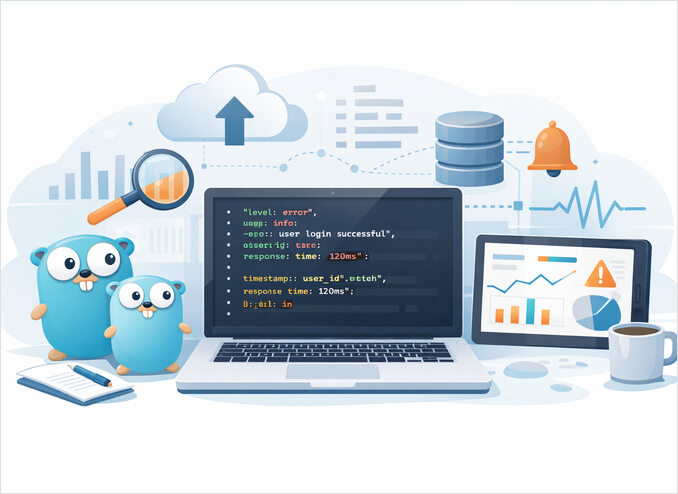
Structured logging is the antidote. It turns every log line into a small event with stable fields, so tools can search and aggregate reliably. For how logs connect to metrics, dashboards, and alerting in the wider stack, see the Observability: Monitoring, Metrics, Prometheus & Grafana Guide.
What structured logging is and why it scales
Structured logging is logging where a record is not just a string, but a message plus typed key value attributes. The idea is boring in the best way: once logs are machine-readable, an incident stops being a grep contest.
A quick comparison:
Plain text (human-first, tool-hostile)
failed to charge card user=42 amount=19.99 ms=842 err=timeout
Structured (tool-first, still readable)
{"msg":"failed to charge card","user_id":42,"amount":19.99,"duration_ms":842,"error":"timeout"}
In production, it helps to think of logs as an event stream emitted by the process, while routing and storage live outside the application. That mental model pushes you toward writing one event per line and keeping events easy to ship and re-process.
Slog in Go as a shared logging front end
Go has had the classic log package since forever, but modern services need levels and fields. The log/slog package (Go 1.21 and later) brings structured logging into the standard library and formalises a common shape for log records: time, level, message, and attributes. For a compact language and command refresher alongside this guide, see the Go Cheatsheet.
The key parts of the model are:
Record
A record is what happened. In slog terms, it contains time, level, message, and a set of attributes. You create records via methods like Info and Error, or via Log when you want to supply the level explicitly.
Attributes
Attributes are the key value pairs that make logs queryable. If you log the same concept under three different keys (user, userId, uid), you get three different datasets. Consistent keys are where the real value hides.
Handler
A handler is how records become bytes. The built-in TextHandler writes key=value output, while JSONHandler writes line-delimited JSON. Handlers are also where redaction, key renaming, and output routing tend to happen.
One under-rated feature is that slog can sit in front of existing code. When you set a default slog logger, top-level slog functions use it, and the classic log package can be redirected to it too. That makes incremental migration possible.
Groups
Groups solve the “every subsystem uses id” problem. You can group a set of attributes for a request (request.method, request.path) or namespace an entire subsystem with WithGroup so keys do not collide.
A production shaped slog setup
The following setup hits the usual goals.
The examples use a small logx package; for where packages like that usually live in a real module, see Go Project Structure: Practices & Patterns.
- one JSON event per line
- logs written to stdout for collection
- stable service metadata attached once
- context-aware logging for request and trace IDs
- central redaction for sensitive keys
package logx

import (
	"log/slog"
	"os"
)

var level slog.LevelVar // defaults to INFO

func New() *slog.Logger {
	opts := &slog.HandlerOptions{
		Level:     &level, // can be changed at runtime
		AddSource: true,   // include file and line when available
		ReplaceAttr: func(groups []string, a slog.Attr) slog.Attr {
			// Centralised redaction: consistent and hard to bypass by accident.
			switch a.Key {
			case "password", "token", "authorization", "api_key":
				return slog.String(a.Key, "[redacted]")
			}
			return a
		},
	}

	h := slog.NewJSONHandler(os.Stdout, opts)

	return slog.New(h).With(
		"service", os.Getenv("SERVICE_NAME"),
		"env", os.Getenv("ENV"),
		"version", os.Getenv("VERSION"),
	)
}

func SetLevel(l slog.Level) { level.Set(l) }
A tiny detail with large consequences: the built-in JSON handler uses standard keys (time, level, msg, source). When your log backend expects a different schema, ReplaceAttr is the pressure-release valve that lets you normalise keys without rewriting call sites.
Schema matters more than the logger
Most “structured logging” failures are schema failures.
Essential fields that keep paying rent
Every log backend will store a timestamp, level, and message. In practice, a useful application schema often adds a small set of stable fields:
- service, env, version
- component (or subsystem)
- event (a stable name for the thing that happened)
- request_id (when a request exists)
- trace_id and span_id (when tracing exists)
- error (string) and error_kind (stable bucket)
Notice the pattern: these fields answer operational questions, not developer curiosity.
Semantic conventions are a cheap consistency hack
If you already use OpenTelemetry, its semantic conventions provide a standard vocabulary for attributes across telemetry signals. Even if you do not export logs via OpenTelemetry, borrowing attribute names reduces the “what did we call this field in service B” tax.
High cardinality and why logs get expensive
High cardinality means “too many unique values”. It is fine inside a JSON payload, but it becomes painful when a backend treats some fields as indexed labels or stream keys. User IDs, IP addresses, random request tokens, and full URLs tend to explode combinations.
The practical outcome is simple: keep labels and index keys boring (service, environment, region), and keep high-cardinality fields inside the structured payload for filtering at query time.
Correlation with request IDs and traces
Correlation is the point where logs stop being just text and start behaving like telemetry.
Request ID as the lowest-friction correlation key
A request ID is the simplest bridge between an incoming request and everything that happens because of it. It tends to work even without distributed tracing, and it is still useful when traces are sampled.
A common pattern is to attach a per-request logger to the context:
package logx

import (
	"context"
	"log/slog"
)

type ctxKey struct{}

func WithLogger(ctx context.Context, l *slog.Logger) context.Context {
	return context.WithValue(ctx, ctxKey{}, l)
}

func FromContext(ctx context.Context) *slog.Logger {
	if l, ok := ctx.Value(ctxKey{}).(*slog.Logger); ok && l != nil {
		return l
	}
	return slog.Default()
}
Trace correlation with W3C Trace Context and OpenTelemetry
W3C Trace Context defines a standard way to propagate trace identity (for HTTP, via traceparent and tracestate). OpenTelemetry builds on that so trace IDs and span IDs can be extracted from context.
This middleware example logs both request_id and trace identifiers when available:
package middleware

import (
	"crypto/rand"
	"encoding/hex"
	"net/http"

	"go.opentelemetry.io/otel/trace"
	"log/slog"

	"example.com/project/logx"
)

func requestID() string {
	var b [16]byte
	_, _ = rand.Read(b[:])
	return hex.EncodeToString(b[:])
}

func WithRequestLogger(base *slog.Logger) func(http.Handler) http.Handler {
	return func(next http.Handler) http.Handler {
		return http.HandlerFunc(func(w http.ResponseWriter, r *http.Request) {
			rid := r.Header.Get("X-Request-Id")
			if rid == "" {
				rid = requestID()
			}

			l := base.With(
				"request_id", rid,
				"method", r.Method,
				"path", r.URL.Path,
			)

			if sc := trace.SpanContextFromContext(r.Context()); sc.IsValid() {
				l = l.With(
					"trace_id", sc.TraceID().String(),
					"span_id", sc.SpanID().String(),
				)
			}

			ctx := logx.WithLogger(r.Context(), l)
			next.ServeHTTP(w, r.WithContext(ctx))
		})
	}
}
Once correlation fields exist, the log line becomes an index into other data. The difference in a live incident is not subtle.
Turning structured logs into monitoring and alerting signals
Logs are great at answering “what happened”. Alerting is usually about “how often and how bad”.
A practical approach is to treat certain log events as counters:
- event=payment_failed
- event=db_timeout
- event=cache_miss
Many platforms can derive log-based metrics by counting matching records over a window. Structured logs make that count resilient, because it is based on a field value rather than a brittle text match. When you are ready to visualise and explore those signals, Install and Use Grafana on Ubuntu: Complete Guide walks through a full Grafana setup you can point at common log and metrics backends.
This is also where log levels start to matter. Debug logs are often valuable, but they are also where cost and noise hides. Using a dynamic level (LevelVar) lets the system stay quiet by default, while still allowing targeted detail when needed.
Closing thoughts
Structured logging in Go is no longer a library debate. The interesting part is whether your log records are consistent, correlatable, and affordable to store.
When your logs carry stable fields like event, request_id, and trace_id, they stop being “strings someone wrote” and start being a dataset you can operate.
Notes
The Go team introduced log/slog in Go 1.21 and emphasised that structured logs use key-value pairs so they can be parsed, filtered, searched, and analysed reliably, and also noted the motivation of providing a common framework shared across the ecosystem.
The log/slog package documentation defines the record model (time, level, message, key-value pairs) and the built-in handlers (TextHandler for key=value and JSONHandler for line-delimited JSON), and documents SetDefault integration with the classic log package.
For distributed correlation, the W3C Trace Context specification standardises traceparent and tracestate propagation, and OpenTelemetry specifies that its SpanContext conforms to W3C Trace Context and exposes TraceId and SpanId, making log-trace correlation straightforward when a span is present.
For log storage cost and performance, Grafana Loki documentation strongly recommends bounded, static labels and warns about high cardinality labels creating too many streams and a huge index, which is directly relevant when deciding what becomes a label vs what stays as an unindexed JSON field.
