
Garage vs MinIO vs AWS S3: Object Storage Comparison and Feature Matrix
AWS S3, Garage, or MinIO - overview and comparison.
AWS S3 remains the “default” baseline for object storage: it is fully managed, strongly consistent, and designed for extremely high durability and availability.
Garage and MinIO are self-hosted, S3-compatible alternatives: Garage is designed for lightweight, geo-distributed small-to-medium clusters, while MinIO emphasises broad S3 API feature coverage and high performance in larger deployments.

From a 2026 risk lens, you should also factor project governance and distribution: the public minio/minio GitHub repository shows as archived and read-only (archived Feb 13, 2026), and MinIO’s documentation repo states that community docs were pulled from web hosting (Oct 10, 2025) with no further doc development planned there.
If you want “no-ops” and a deep ecosystem, AWS S3 is usually the safe default; if you need data sovereignty, predictable infra costs, or edge deployments, self-hosting may be justified—then Garage vs MinIO depends mostly on your required S3 features and your operational maturity.
For the broader picture—object storage, PostgreSQL, Elasticsearch, and AI-native data layers—see the Data Infrastructure for AI Systems article.
Comparison frame and decision drivers
When teams say “MinIO vs Garage vs AWS S3”, they’re usually deciding across these drivers:
S3 API surface area and semantics. Garage aims for S3 compatibility but does not implement ACLs or bucket policies and (per its compatibility table) does not support bucket versioning; MinIO and AWS S3 provide much broader feature sets.
Availability and durability model. AWS S3 is designed for 11 nines durability and provides strong consistency; self-hosted systems’ durability depends on your design (replication, disks, zones, ops).
Operational burden. AWS manages hardware, scaling and many security guardrails; in self-hosted designs you own hardware, upgrades, monitoring, and incident response.
Cost model. AWS prices include stored GB-month plus requests and data transfer; self-hosted cost is dominated by capital/hosting plus labour, but you might avoid request-based billing.
Roadmap/governance risk. If upstream distribution, docs, or contribution flow changes, self-hosted ops can become more expensive.
Architecture models and scalability
Mental model of “how they scale”
AWS S3 is a managed regional service: you place objects in buckets and AWS handles scaling and multi-AZ durability; AWS S3 provides strong read-after-write consistency and a huge feature set around IAM, lifecycle, eventing and storage classes.
MinIO is typically deployed as a distributed cluster (erasure coding and multi-node topologies are commonly recommended for production), with features like bucket versioning, lifecycle, replication and event notifications.
MinIO’s own scaling materials present linear scaling with additional hardware (with the obvious asterisk that real performance depends on your disks, network and tuning).
Garage is built to be light, geo-distributed, and simple to operate. It uses cluster “layouts” with node roles (storage vs gateway), zones, and replication factors, and highlights the avoidance of consensus leaders as a performance benefit in high-latency setups.
Decision flow
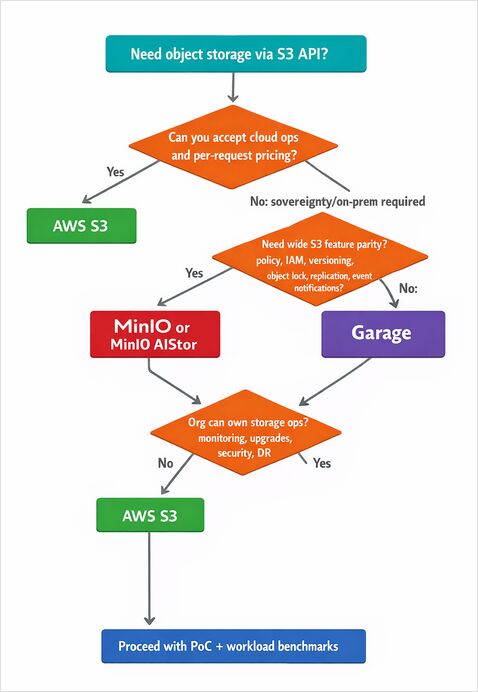
Feature matrix
This table focuses on “decision-grade” features that commonly break migrations.
| Capability | Garage | MinIO | AWS S3 |
|---|---|---|---|
| S3 signatures (SigV4) | Yes | Yes (S3-compatible) | Yes |
| Path-style + vhost-style buckets | Both (vhost via root_domain; path always on) |
Both (AIStor claims support) | Both (AWS docs) |
| Bucket policies / ACLs | Not implemented (Garage has its own key→bucket permission model) | Yes (policy-based access control is core) | Yes (IAM + bucket policies; ACLs optional) |
| Bucket versioning | No (per Garage compatibility status) | Yes | Yes |
| Object Lock / WORM | No (per Garage compatibility status) | Yes | Yes |
| Replication via S3 replication APIs | No (Garage replication endpoints missing) | Yes (bucket replication relies on versioning) | Yes (S3 replication features + metrics/events) |
| Lifecycle management | Partial (some lifecycle actions; see compatibility list) | Yes (broad ILM / tiering) | Yes |
| Event notifications | Not highlighted as a core Garage feature (validate for your use case) | Yes (bucket notifications guide) | Yes (at-least-once delivery) |
| Built-in static website hosting (S3 website endpoints) | Yes (s3_web + website endpoints) | Commonly handled via proxy/CDN; Garage docs explicitly call out this as uncommon among alternatives such as MinIO | Yes |
| Server-side encryption | SSE-C supported; bucket encryption endpoints missing | SSE-C and SSE-S3 (KMS) supported | Default encryption with SSE-S3 on new objects since 2023 |
| Observability | Prometheus metrics + OpenTelemetry traces | Prometheus metrics and server log interfaces | CloudWatch + server access logging options |
Performance, cost and operational complexity
Performance
AWS S3 publishes design guidance for high request rates and patterns such as using caching layers or Transfer Acceleration for geographic distance, and it automatically scales to high request rates.
MinIO positions itself as high-performance storage where throughput is driven by your hardware, and provides its own benchmarking tool (Warp) to measure S3 workloads.
Garage’s benchmarks and performance blog focus on geo-distribution and the costs of inter-node latency; they also caution that comparing systems with different feature sets (e.g., MinIO erasure coding vs Garage replication) requires context.
Practical guidance: benchmark your workload mix (object sizes, concurrency, latency, read/write ratio) using a tool like Warp; expect results to vary drastically based on disks, network and configuration.
Cost model
AWS S3 pricing is multi-dimensional: storage, requests, retrievals and data transfer; storage class choice can dominate total costs depending on access pattern.
Self-hosted systems shift cost into infra (servers, disks, networking, power/colocation) and, critically, people time for operations (patching, monitoring, on-call, incident response). Garage explicitly frames “operations & maintenance” as a key part of running a cluster.
MinIO offers commercial subscriptions (AIStor tiers) with bundled enterprise features and support.
A simplified comparison:
| Dimension | Garage (self-hosted) | MinIO (self-hosted / AIStor) | AWS S3 |
|---|---|---|---|
| Core spend | Hardware + ops time | Hardware + ops time (+ subscription if AIStor) | Usage-based pricing (GB-month, requests, transfer) |
| Scaling cost | Buy disks/nodes; manage rebalancing | Buy disks/nodes; manage erasure/replication features | Elastic; pay-as-you-go |
| “Hidden” costs | Ops maturity, DR drills, monitoring | Same + governance changes risk | Ingress/egress and request micro-costs |
Operational complexity and security shape
AWS S3 provides a mature access-control stack and security posture, including encryption defaults and extensive monitoring/auditing integrations.
Garage’s access control is intentionally simpler (key-to-bucket permissions), and it expects you to provide TLS via reverse proxy; this can be a benefit (less IAM sprawl) or a limitation (less fine-grained policy).
MinIO provides policy-based user management and a rich set of object governance features (versioning, object locking, replication, notifications), but you must secure and operate the whole stack.
Also consider licensing: Garage is AGPLv3 and MinIO is AGPLv3 (with commercial licence options for MinIO); AGPL obligations matter if you modify the software and provide it over a network.
Migration and interoperability considerations
The “happy path” migration is often: copy objects + recreate buckets/config + migrate access control.
For bulk copy/sync between S3-compatible endpoints, tools like rclone support S3 and many S3-compatible services and can mirror buckets between providers.
For backup-style migration, restic supports S3-compatible backends and can store encrypted deduplicated backups in S3 buckets.
Watch-outs that cause real incidents:
Client addressing style: some environments require vhost-style; Garage supports it only when root_domain + wildcard DNS/cert are configured, while path-style is always on.
Policy translation: Garage does not accept PutBucketPolicy; you must redesign permissions as bucket/key grants.
Versioning/object lock: if your app depends on version IDs or WORM retention, Garage is not a drop-in replacement today; MinIO and AWS S3 both support these.
Recommendations
Choose AWS S3 when you want managed durability/availability, broad feature coverage (IAM, lifecycle, eventing, storage classes), and you are comfortable with usage-based pricing and cloud governance.
Choose Garage when you want a lightweight self-hosted S3 core, geo-distribution via replication across zones, and you can accept its S3 feature gaps (no bucket policies/ACLs; no versioning) in return for simpler operations and design.
Choose MinIO / MinIO AIStor when you need richer S3 feature coverage (versioning, replication, notifications, object locking, SSE variants) and you have the hardware and operational maturity to run it—or you explicitly plan for the subscription/support model.
Finally, treat upstream project state as a due-diligence item: the minio/minio repository shows as archived read-only as of Feb 13, 2026, and MinIO’s docs repo describes a documentation hosting shift (Oct 10, 2025). Validate your intended distribution and support model before committing.
Useful links
- Garage - S3 compatible object storage Quickstart
- Minio as Aws S3 alternative. Minio overview and install
- MinIO Commandline Parameters Cheatsheet
- Garage HQ
- Garage features
- Garage S3 compatibility
- MinIO AIStor S3 API
- MinIO pricing
- MinIO commercial license
- AWS S3 user guide
- AWS S3 durability model
- AWS S3 pricing
